Latest Posts

Showing posts with label fiction writer. Show all posts

Talented author Gorg David Huff of Austin, Texas has agreed to an interview to tell us about his adventures in writing.  This is a road not traveled alone and he reveals to us how others have affected his writing career along the way. Rather than be a man of many trades, he decided to put his all into writing and it has become his life's work.
1636: The Viennese Waltz (The Ring of Fire) Gorg Huff
Book #18 in the multiple New York Times
 best-selling Ring of Fire series


What is your genre? 

Now that's a question that is subject to interpretation. If you mean writing, painting, sculpting, music, then it's mostly writing with a bit of cartography and some painting. As to type of writing, it's science fiction, mostly alternate history, but also magic and space opera. The painting is mostly impressionism to abstract.

What can you tell us about "Ritter" in particular?

A decent respect for the opinions of mankind compels me to define Ritter. A ritter, in this case, is not a German knight, but a writer who can't spell. Not being able to spell, as you might imagine, makes the writing process somewhat more difficult. It makes or made for most of my life, being published not just impossible but unthinkable. Even now with the literally amazing advances in spell checking, I'm still close to unpublishable without my co-author Paula Goodlett, who can spell as well as find the many and varied other errors that creep into anything I write.

How long have you considered yourself a writer?

From the moment someone paid me for a story. In my case that was the publication of "The Sewing Circle" in the first Grantville Gazette electronic version. If I recall correctly, I was paid two and a half cents a word. The paper version of GGI was published in 2004, so the electronic magazine was probably in '02 or '03.

Marcy Luikart of Santa Barbara, California is primarily a writer, however, she also exercises her creativity by painting and playing the fiddle. She approached me with the idea of discussing in her interview how the different art forms infuse the writing. For example how does a writer "paint" a picture with words; is it similar to the process of putting color on canvas?  

Luikart's current novel is River Braids which tells us stories spanning 100 years.  In this interview she will be talking about the novel in terms of the visual process involved in addition to sharing from her personal experiences as a writer. Her short stories have appeared in The Iconoclast, Bellowing Ark, Pangolin Papers, Beginnings, QWF, and the Connecticut Review.

river braids cover photo for book
How long have you been writing in your current genre?

I've been writing my whole life.  This is my first historical fiction novel, but in reality writing historical fiction was more of an accident for me.  I started out writing a short story and while researching my story I found myself back at the 1904 World’s Fair. And then I found myself with a big “what if?” And the next thing I knew I was writing a novel.  Prior to this I was primarily a short story writer.  And I've got a couple of unfinished mysteries floating around on my hard drive.  I don’t have a genre. Each story is a new story and it tells me where it wants to go. What genre it wants to be. I know that’s not the trend. Writers are supposed to fit into a neat marketing box, but for me it’s all about the story.  I read all kinds of stories, mysteries, sci-fi, fantasy, literary. I love all stories, and I like to write all stories.

What inspires and motivates you to write?

People motivate me.  I write to discover people.  And ultimately I discover myself.  There is something very exciting about putting people in imaginary circumstances and watching where they go. Sometimes it begins with a place and I imagine the people who live in that place.  Sometimes it’s a picture and I find myself wanting to know the story hidden in the picture.


book cover art steampunk novel
Brooke is the author of The Brass Giant and The Mechanical Theater (initially released as The Clockwork Giant and Le Theatre Mecanique) part of the Chroniker City series for young adults. Her geeky obsession with mechanical science and history is the driving force behind her writing, flavoring her steampunk with scientific accuracy and her fantasy with the rich cultures of ancient civilizations. When she isn't writing, she enjoys a plethora of hobbies: drawing, painting, paper-craft, sewing, and baking a Jack of all trades, master of none, in true bardic fashion.

If the world were a tabletop role-playing game, she would be the studious bard of the party, her husband the fiercely-bearded paladin, their dog the cowardly wizard who only knows one spell, and very soon to join them, their daughter, who will certainly choose her class once she arrives. They currently reside in Northwest Arkansas, but once they earn enough loot and experience, they'll build a proper castle in the mountains, defending themselves against all manner of dragons and goblin-kind. 


book cover Chroniker book one
How long have you considered yourself a writer?

I was twelve when I made the decision to be a writer, but I don't think I ever really considered myself a "real" writer until after I graduated college. Until then, I had been a student, an artist, a gamer, spending very little time actually writing. But after college, I dove headfirst into the career I wanted to devote my life to, spending hours upon hours working on my stories every day, not just an hour or two a week. When people asked what I did, I could tell them I was a writer because that's what I did day-to-day; it became my job.


What inspires and motivates you to write?

Various things inspire me —a line from a book, a character from a movie, a random thought or dream, a painting or drawing, or even just a name or a combination of words. I don't try to explain where my inspiration comes from. It just happens, sometimes when I'm looking for it, sometimes when I'm not. But what gives me the most inspiration, what really inspires me to write, is reading a good book. Reading a good book makes me want to write something that someone else will read and be inspired. Really, that's the driving motivation behind my writing. I want to share stories. I want to make people cry because they care about a character I created. I want people to dream about the worlds in my stories. I want them to believe, for just a moment, that the world I created with my words, the people who live there, that it's all real, that if they could step through the pages of my book, they'd find a real place and real people, and hopefully, they wouldn't want to leave. That's what I want to accomplish with my stories, and that's why I keep writing, to share those stories, to share those worlds and people with others. Otherwise, they'd only exist in my head, and that's not fair.

Why Steampunk and how did you come to write Y.A.?

I sort of stumbled into writing steampunk by accident. Before writing my first steampunk novel, The Brass Giant, I was in the middle of editing a garbled mess of a fantasy novel, and it wasn't going well. One night, lying awake in bed, I had a thought: A machine is truth. It was an odd thought, and I wondered who would think such a thing. So I started exploring the idea, and out of it came my main character, a clockwork mechanic, and my setting, a city built on steam and clockwork technology. I had read a few steampunk novels by this point, and the thought of writing one terrified me since I had only ever written fantasy, but I had a story to tell. So I did.

Writing young adult fiction was also a sort of accident. My favorite stories are middle grade, meant for readers between the ages of eight and twelve, and I always wanted to write stories for that age group, but every time I came up with a story idea, it didn't fit middle grade. My protagonists were too old, their problems too complicated, and of course, I have a fondness for romance that's better suited for teenagers and older. Writing young adult wasn't really a decision so much as my stories just happening to fall into the young adult genre. My actual writing style also lends itself more toward young adult and middle grade instead of regular adult fiction. I write very simply, which works well for children's fiction and young adult.

What is the publishing process like?

The actual act of publishing a book is pretty simple. It's getting to that point that takes time and effort. My process from first draft to finished product is pretty similar from book to book. Once the first draft is done, I let it sit and mellow for a while, spending time working on something else to get my mind off it. Then I go back and do my first round of edits. After that, I might send it to beta-readers or do another edit after some time away, especially if I made a lot of changes in the first edit. I usually like for the story to be as good as I think I can make it before sending it to betas. Once it's with betas, I spend that time working on something else, usually whatever I worked on while letting the story sit after finishing the first draft. This is usually two months or so. And then once I have all of my beta feedback, I go over all their comments and follow-up with them with more specific questions if I have them. Then I do what I call my beta edit according to their feedback. After that, the book will sit for a few weeks while I work on cover art, formatting, marketing, and any other product packaging for publication. I'll do one more edit after that, make adjustments to the product packaging accordingly, and then get everything ready with retailers so that when I near my publication date, all I have to do is press "Publish."

I'm pretty lucky that I know how to do most of this stuff on my own. I have a background in graphic design and art, so I do my own cover art. I may work with another artist sometime in the future, when I have more funds to play with, but until then, I'm confident in my own work. Formatting comes pretty easy to me, and ever since publishing my first book, I now draft in the format I plan to publish in. The hardest part is always the editing —knowing what to cut, what to keep, what to change. Sometimes, it requires a second opinion, even before the beta stage, especially if I'm having a really hard time looking at the story objectively. And it takes the most time. I easily spend twice as much time editing as I do writing. 

But once the book is edited and formatted and has cover art, all I have to do is upload the files to Kindle, Barnes & Noble, Kobo, Smashwords, and Createspace, make sure everything looks like it's supposed to, and publish. 

What’s your typical writing session and environment like?

My desk is generally pretty cluttered. I have a bad habit of sticking post it notes and to-do lists everywhere, and because I snack quite a bit, there are usually dirty dishes, pudding cups, and half a dozen empty water bottles littering my work space. I likely have a chapter or two of my current manuscript printed out and marked up in pen, maybe a few handwritten pages of scenes or brainstorming notes half-hidden beneath my keyboard. My plot board is close by, scene cards pinned to a cork-board with pretty colored, star-shaped push-pins. 

I generally start working after lunch, once all the goofing-off-on-the-internet is done and I know I won't be disturbed. I sit at my desk, open up whatever manuscript document I happen to be working on, and start reading over the previous day's work before writing new words. I have Google+ chat going on my second monitor so that I can talk to my writer friends during the day, and depending on what I'm working on, I might have a document or two relating to the manuscript open for reference. While I write, I listen to music —usually film scores and video game soundtracks, sometimes techno. I very rarely listen to anything with lyrics. 

I tend to write in hour-long spurts and take short ten to fifteen minute breaks between. I aim for 500 words per hour, which is a really good pace for me. It's challenging but doable. I usually get three to four hours of solid writing done in the afternoon. Sometimes, I'll write another hour or two after dinner if I'm feeling particularly productive, but most of the time, my day is done when my husband gets home from work. The afternoon is my best writing time. In the morning, I'm too sleepy and distracted, and at night, I like spending time with my husband. This is likely to change soon, as we're expecting an addition to the family this fall, but I'm sure I'll figure out a new schedule eventually, even if it's not as productive as before.

What tools do you prefer to write with?

I write on a desktop computer, dual monitors for sufficient work-space, and an ergonomic keyboard for comfort. I draft in Microsoft Word 2010, which baffles many of my writer friends, who all use Scrivener, but Word works well for the way I write.

What is the most surprising response you have had to your writing?

Honestly, the thing that surprised me most was whenever my grandma read my novella. I thought she might like it, since it's a quieter, character-driven story, but I never expected her to like it so much that she read it in one sitting because she couldn't put it down. I think I always wanted her to believe in my writing and prove to her that I made a good choice with my career, so when she read my book and loved it, it sort of validated my career. I wouldn't have quit writing or anything had she not liked it, but the fact that she enjoyed my book and is proud of me and my writing, it means a lot to have that support from family, especially from a family member who thinks that job security is more important than following your dreams. 

Do you have any regrets pertaining to your writing?

Two. First, I regret rushing to publish my first book. I didn't really understand how important editing was, and I think had I waited, my book would be much better than it is. I'm still happy with it, but I think it could have been better if I would have given it the time and attention it deserved. In the future, I'll give each book the amount of time it really needs, even if that means pushing my deadlines and publication goals back. Second, I wish I trusted myself more. This is more of a general regret, but too often, I doubt myself when it comes to my work, and I make bad decisions based on that. It's something I'm working on. 

What plans do you have for future work?

My career goal is to publish fifty books. I've published two so far, so I have forty-eight to go. For short-term goals, I have the final two books in the Chroniker City series to write—The Guild Conspiracy and The Chroniker Legacy —which I plan to publish in 2014 and 2015, respectively, and I also have The Wizard's Heart, a fantasy novel in the middle of edits that I plan to publish next year. Outside of those books, I plan on pursuing traditional publication with a middle-grade fantasy that's still mulling about in my head. By the time I finish all of that, I'm likely to have twenty more ideas begging to be written.

What advice would you give to aspiring authors?

Write what you're passionate about. I've seen too many young writers write what they think will sell, or they write what other people tell them to write. They give up on the books they love because people tell them that no one reads those books, that it's not "real literature", or that publishers won't buy a book like that. Nonsense. If you write what you're passionate about, you'll write something worth reading. It's as simple as that.

Find Brooke Johnson online…
writer profile photo
Available on Amazon:


Collapsus Submarine Channel Best Practice Poster
Promo poster for Collapsus
Comic books have evolved into the graphic novels popular today reaching out to a more diverse and mature audience. Rich storylines illustrated with artwork offer something for just about everyone. This unique format is able to stand alone as a single novel, however, graphic novels tend to span over a series. Many who read them are also in the habit of acquiring a collection.

Online print-on-demand or digital channels of distribution prove extremely promising now that many readers will download to tablets. Diamond Distribution, the comic store direct market distributor, makes it hard for independent writers to even be listed unless they are generating a certain amount of monthly revenue. Publishers expect YOU to promote your book if you are an independent creator.  A major plus for graphic novels are that they are not limited to comic vendors as far as direct marketing goes. The following is a list of ideas on how to go about promotion of a graphic novel once it is published.
  •  Research graphic novel related web sites and community message boards.  Become a fixture on the forums and if there is a blog community there, post some entries and make sure to comment on others’ posts.  Build some online cred this way, so you have a good base market warmed up to you already.  Some popular online hangouts to start with are: ArtBomb, The Pulse on Comicon, Absolute Write, Comic Book Resources, Media Bistro and The Comics Journal.
  •  Get a website or blog specifically to showcase your graphic novel.  Update with news, show off your art and share any tantalizing press.  Have a free preview download and create posts that are of the “behind-the-scenes” variety.  A cast-page with the main characters and brief descriptions of them will give a nice sneak-peak and builds some background for future readers and a reference for those that are already reading.
  •  Get interviews and novel reviews.  You may want to start with contacting local reviewers at newspapers, magazines, blogs or websites. Offer a free digital copy and give a brief description of your novel. Kirkus has reviewed many graphic novels and is a highly regarded source.  If you have a healthy advertising budget you should be able to foot the $400-500 review cost.
  •  Word of mouth, as in conversations - don’t be too shy to let people know that you are a writer and have recently written a book.  Have a business card with your site or blog address on it where they can see a preview of the content in your graphic novel.  If you can carry a printed version with you, do so.  Having seen it will solidify the book in their minds and many will likely spread the word that they met a published writer and it will grow from there.
Comicstore
Comic shop with graphic novels on shelves.
  •  Of special consideration in how to promote graphic novels depends on your target readership.  If you want to reach a specific audience, find out the channels of communications best suited to target this group.  Focus on those especially.
  •  Crowd-funding is a highly accessible and easy way to start getting the word out while also funding your initial startup costs.  Kickstarter, and GoFUndMe campaigns have proven time and time again to be effective and provide a way for independent creatives to get their work to the public while involving said public in their production.  Called “backers”, the crowd-source investors are often customers getting a sneak-peak or calling dibs on what is to come.  If you look at current campaigns on such sites you will note that the trend is towards giving something special as a thank you for supporters.  It is, in a way, the pre-sale before the main launch.  Graphic novels are made up of both illustration and creative writing.  Signed posters or postcards and even downloads of digitized bonus material are great rewards that also help those that help fund you use as marketing tools.  It is a win-win.  Read more about crowd-funding in this article: Artists: Answers to Your Crowd-Funding Questions.

    You do not have to limit yourself to online sources, having a fundraising event is something that has been around much longer than the internet, and it can be very fun and create quite a buzz in your community.
      At a live event you can have costumed hosts representing the characters from your novel and even have a video presentation or live reading/ re-enactment of scenes from the graphic novel you are promoting. 

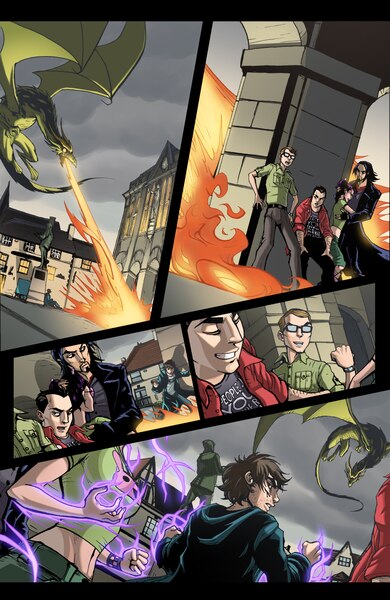
Page 17 of The Interactives
"The Interactives" Graphic Novel.
Official Blog Preview Here

Sometimes after you get set up self-publishing and run some campaigns on your own, publishers and agents start to show interest.  At that point you will be empowered to pick and choose whether to branch out and explore the options they offer or not.  The best thing is being able to maintain total control of your work and how it is represented.  If you get the ball rolling on promotion you will already have set the stage for how the public will be engaged in your graphic novel.  And then… time to consider your series and even possible spin-offs.  

Reading this information focused on self-promotion of a graphic novel is just a start in getting your work out there and noticed. Get some more ideas by reading further:  Passive Marketing: 9 Powerful No-Cost Ways To Help Boost Book Sales.


Udemy course on creative professional marketing strategies
Photo of Bobby Bergner author of Dead Stir
Dead Stir author, Bobby Bergner

R.L. Bergner based in Phoenixville, Pennsylvania writes Horror, Fantasy and also Humor. He has sold 2100 copies of his first children's book over the last five years. The Kindle edition of one of his books is doing very well in the UK - seven copies a week average. His popular serial blog Dead Stir was inspired after being repeatedly disappointed by the genres he loves.


Bobby Bergner looking intense or scary
all images © R.L. Bergner

"I wanted to write something original where the reader would have an uneasiness and uncertainty as to how the story would progress. Dead Stir is my love letter to some of my favorite genres filled with everything I would ever want to experience in good storytelling."


The first draft of Dead Stir was released as a serial blog over the span of 6 months. The blog version of the story was chock-full of grammatical errors, but in its essence delivers a compelling adventure. Dead Stir was written in real time with posts nearly every day to help give the reader a sense of reality to its timeline and keep them coming back to see what happens next. The serial blog is no longer available for reading since the polished novel is nearing completion.

"I hope it inspires others to create something of their own based on what they are passionate about."
Dead Stir Serial Blog Promo Image and Text Graphic
Dead Stir, the Journey from Idea to Reality
*Click on the graphic above for R.L. Bergner's blog.


R.L. Bergner recently sat down and shared some insight into his writing:


How long have you considered yourself a writer?

I would consider that I have been telling stories since before I could write.

What inspires and motivates you to write?

Writing is creating and I am forced to create when my brain is overflowing with ideas. I would say that I have to write more than I am motivated to write, because my mind is constantly racing with a swirl of images and ideas that I must get out of me or risk death by suffocation. 

How did you start out?