Latest Posts

Showing posts sorted by relevance for query drawing. Sort by date Show all posts
I am pleased to be presenting Digital Artist and Illustrator Marcylittleninja, also known as Ma-chan. She created her artist name over the years, originally known as Littleninja, later attaching her name 'Marcy'.  Ma-chan, her second name was given to her through Japanese pen pals.  So, as she explains "both names are a part of me."  If you look to her Artist Watermark/Logo both names are there.

Although her style of drawing has changed at various times in her life, the unique visual quality of Manga or anime-styled drawings became her focus during her high school years and has continued. Marcylittleninja adapted certain styles from different artists who were in the 'Shoujo' genre of Manga comics (Shoujo: Aimed towards female audiences and the style has the males drawn very attractively while the females are drawn cute and delicate looking).  Despite her deep interest in manga, her favorite artist, Yone Kazuki, is not in the Manga Industry but in the Visual Novel 'Otome' / 'Maiden' game industry and does the character designs and artwork for visual novel games. Kazuki has the biggest influence on Marcylittleninja's artwork because she credits her as the inspiration to keep improving and to move forward in her artistic career. 

Marcylittleninja has been drawing for more than 13 years and has studied around 4-5 years of Visual Art. She started out with modest means and so was self-taught at first. Regarding her formal artistic training she tells me,

"I didn't enjoy using charcoal or painting [these caused headaches]. Every time I went to classes I was always going just for the digital class... and for the life drawing classes which helped me a lot with my anatomy drawing. It wasn't until 2012 that I started creating Digitally after I received a grant through a local youth centre for funding help towards getting a graphic tablet. I'm still sitting here crying tears of happiness for that help.  After a week of using it I improved 10 xxx as much as I was originally drawing."
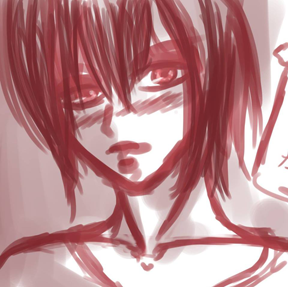
selfportrait, Japanese style
Artist Self-portrait  © Marcylittleninja
When did you first come to think of yourself as an artist?

This is a hard one to answer because being an artist is the one thing that’s always existed for me. I never once thought otherwise. I grew up with the artist lifestyle which I didn't choose, or have it chosen for me since it was just the way things were for me to begin with. I actually never even said "I'm going to grow up and be an artist for my career of choice," I personally felt that I've always been an artist. I look at the word artist as just a word that describes what I am, what I do, how I live and Drawing has always came naturally for me. I always have these moments or urges to draw something. When those urges happen, the entire world gets put on hold, sleep can wait, food and water can wait, even friends and family can wait because when I start drawing, it must be complete before I continue with other things. I cannot remember if there was even a time before this lifestyle for me so to put it bluntly, I never thought of myself as an artist, I knew from the beginning of this life that I am an artist. When it comes to actually speaking about careers, I did waver at the age of 13-14 because I was made to believe that being who I was, wasn't a career and that I should be working at places like supermarkets and whatever. Even now, if I hear people speaking to me like that I become protective of my art and you might even call it being selfish because I personally won't work anywhere that isn't relating to art or where I cannot draw, create or design something. "If it's not art, it has no interest to me, nor does it hold any meaning to my life." I've always been stuck on art with determination to keep on improving.

Why Anime/Manga Styled Illustrations?

I don't really look at it as 'anime/manga styled' but that’s how others view them seeing it's influenced by Japanese Artists.  I think this is also going to be hard to explain because this has always been something for me, I can't remember what I was like before I started.  I've always been interested in Japan and its culture since I was very young so you could say that I've always been immersed in that culture. I wanted to read manga in its original language so I took up learning Japanese from a young age.  I watched a lot of Anime, and read a lot of Manga, too many to count or name. I'm a very visual learner so I can pick up on differences in styles from reading or watching in very little time at all.  I felt drawn to the styles of drawing in Japanese Manga. When it comes to art, I like to draw things that I can emotionally become attached to in some kind of way, or express anything. You can do that with any art but for me, this was my thing that I was drawn to and felt natural with.


There are many genres and sub genres for Manga (Japanese Comics) that means depending on the genre and targeted audience would also determine what kind of art style it would have. Personally I've always been attracted to Shoujo Manga. Shoujo manga is targeted at young female audiences and contain mostly romance. There are two main genres 'Shounen for young males: usually has fighting/Action as a base genre, and Shoujo for young females: usually has romance as a base genre. The style of art in shoujo was intriguing to me. Both shounen and shoujo (which is Seinen and Josei when targeting older audiences) have different art styles. Shounen is more roughly drawn while shoujo is soft in appearance. Romance Scenes in Shoujo manga literally grab onto you and you feel yourself overwhelmed with the emotion from what you can see on the page. That’s what I fell in love with and I wanted to be able to draw romance scenes that would grab onto you with emotion. The Mangaka (what Manga Artists are called in Japan) tend to draw the male characters very ikemen in shoujo. Japanese ikemen:  good-looking man/Attractive Man, they usually are taller than the female characters and are masculine but not over the top with body mass, its more the looks that are an important thing for shoujo- Males are slim and handsome, while the females are petite and have large eyes because large eyes are 'cute' for shoujo. I love to draw anything and everything handsome or pretty.

asura, marcylittleninja, ma-chan, Japanese
An interpretation of the buddhist 'Asura'
Random Drawing  © Marcylittleninja
Here I am pleased to be interviewing the prolific artist D.K.Osorio from Northern California. D. K. works primarily in pen and ink drawings and oil paintings, but has been branching out recently into photography. Her black and white abstract and surrealist pieces are the most extensive part of her current body of artwork.

Abstract ink drawing
Pendulum Swing  © D.K. Osorio,
A keeper of time where there is none except you.

How long have you considered yourself an artist?
Ever since I was a little girl, drawing Snoopy cartoons.
Tell me about your first experience creating in your current medium:
My first experience in my current medium in pen drawing was around Halloween of 2012. There is for me a constantly present evolving need to create something challenging the metaphysical. And one creative source that I had yet to tap was my dark neurosis that I felt was too disturbing to express to a public forum. However, Halloween presented itself as a golden opportunity to expose this part of my creativity with some comfort.
What results are you looking for in response to your art?
To draw the viewer to experience an emotion that makes he or she react, no matter how positively or negatively. As long as they feel passionately for an artwork that I created then there becomes a strong connection, a link between them and my creative soul.
Abstract ink drawing
And She Was © D.K. Osorio,
Joining the world of missing persons. 
Missing enough to feel alright.
What does your art mean to you?
What it conveys is an extension of what I am feeling at the time. What I am experiencing in my day-to-day life will show up in my work.

What is the most annoying remark made to you about your art?
Someone once told me that they liked my art so much that they were going to make copies of it, and put it on their wall.

Do you have any regrets in your life as an artist?
The one regret I have is not having complete confidence in myself as an artist. It is always a constant battle in my head. Especially when I create an artwork that I feel is not up to the standards of others. I am my own worst critic.

What plans do you have for the future of your art?
The plans for my drawings are to one day publish them in a book, possibly in coffee book format telling a story behind each one or interconnect them into one story.

Do you have any advice for emerging artists?
Never stop marketing!
Abstract ink drawing

 A Shed Tear For You © D.K. Osorio,

lot of emotion behind one small drop of water.
How to find D.K. Osorio online….
Abstract ink drawing
In The Hall  © D.K. Osorio,
 A tribal urge among broken glass.


Austin Artist, Phil Machi
One of the great things about living in a city with a thriving art culture is being able to get out and meet great local talent. Today I have the pleasure to bring to you an interview with Phil Machi, an artist I met earlier this month at the Staple! exhibition in Austin, Texas. Phil has a unique talent of combining drawing with storytelling as he has done with his comics Retail Sunshine and LivestockPhil received his degree in Digital Art from Bowling Green State University in December 2003. He lived the whole 32 years of his existence in Ohio until relocating to Austin, Texas in July 2013.

So, Phil what drew you to Austin, Texas?

I needed a life-reboot. Austin was the perfect combination of art, music, metropolis and better weather! 

I have seen some of your dinosaur drawings, what is your current project called?

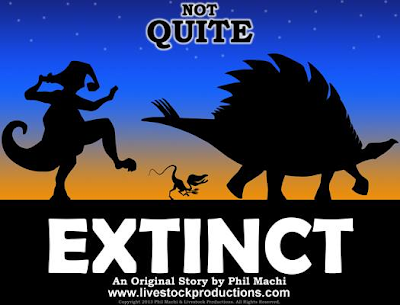
"Not Quite Extinct" is the name of this book. If it continues as planned then it will gain an obligatory "Book 2" after the title, and so on...

Now is this a illustrations-only kind of book or will there also be accompanying text?

There's definitely text involved, but this first volume is going to feel a little mixed because there is a section with only pictures and it doesn't help that one of the main characters is mute.

You are not diverging too far from your usual creative work then.  Will "Not Quite Extinct" have a comic book feel to it? 

As far as my usual "all-audiences" style is concerned, it fits in line with that, to be sure. But it's more epic than my previous comics and certainly less cynical than "Retail Sunshine." I am formatting this book in the traditional vertical comic book format which is also new for me as my past comics had a horizontal arrangement.

Illustration of three dinosaurs which are characters in the story Not Quite Extinct by Phil Machi
All images © Phil Machi

And why dinosaurs?

Ahhh, why dinosaurs indeed. You want the long version or the version you would actually want to read... I'm only kidding. So, believe it or not, this project goes all the way back to when I was in 2nd grade! My teacher Mrs. Divis taught us a segment on dinosaurs and it was absolutely love at first sight for me! I knew instantly that I wanted to make dinosaurs my life; that or stand-up comedy. I kid you not, for years that's what I told people, "Paleontology or stand-up comedy!" I don't remember everything from that age but I do recall getting into drawing more and more. I was practically raised on animation and Sunday comic strips!

Dinosaurs give us a glance at what was - I can see the inspiration.

Oh, absolutely! I was enthralled with their shapes and sizes not to mention all the different varieties. One of the projects for Mrs. Divis involved making hand-made books.This was also a big deal for me and so I took it upon myself to write a story about 2 dinosaurs that become friends and go on an adventure. One of those characters was a Stegosaurus.

What does incorporating dinosaurs into your work mean to you personally; what sense of purpose is driving this project?

For years, I was obsessed. I remember running around in my back yard pretending that I had turned into a Stegosaurus! I used to go around saying things like,"If I can learn more about our past, I can maybe see where our future lays." I have also had a life-long fascination and love for animals. Combine my love for animals and understanding them with my dino-obsession and passion for drawing... you can see where this is going. The problem was I never felt I had the proper skill level to create or draw dinosaurs the way I wanted to so this idea has continually been shelved.

So how did you come up with the mute dinosaur and why include such a character?

I'm not sure what it is about me and mute characters. It's like a "thing" for me.  If I had to guess, I would say I grew up watching characters like The Pink Panther Tom & Jerry and Wile E. Coyote. They were typically mute and I think that resonated with me because when they would occasionally end up speaking I always felt the dialogue ruined the impact. I used to think "that's not what that character should sound like!" There is something inherently magical about pantomime... it beckons curiosity. I would say facial expressions have always meant more to me than words. I try to carry that into my own work.

Stegosaurus cartoon with a large insect that looks like a dragonfly on its snoot


I bet that can be a real challenge to your skills too.  Do you find that you often challenge yourself?

I have always felt that I've been striving for an idealized version of the characters I create. I continue trying to capture their essence and whenever I get it right, I just get so excited and at the same time I fear I won't be able to repeat it. It's difficult with this project because I don't want there to be an obvious growth spurt throughout the book. I am doing my best to make it feel like one continuous story. With my previous comics, it's clear that I was finding my way.

But at the same time, in doing so, I AM growing. I can see it happening from panel to panel.

Has anyone else's work influenced you in this endeavor?

As for other artists... John K. (creator of Ren & Stimpy) was a big influence for me. Also, all of the classic stuff. I grew up on Warner Bros. cartoons, Disney classics and that left a big impression on me. Not to mention countless illustrators and comic strip artists. Specifically, Berkeley Breathed, Gary Larson, Robin James, Jim Henson, Mike Peters and James Gurney.

How do you hope people will react to your "Not Quite Extinct" dinosaur comic?

Everyone is so quick to label things these days, and I would really love to defy those labels and create something that children of ALL ages can appreciate. I would love it if my drawings could keep their attention as much as, if not more than, a paragraph of dialogue. I've often seen people leaf through comics and it just kills me inside because I know how much time goes into each and every panel, not to mention writing and re-writing dialogue.

Yes you are right, this is a fast-paced world with especially shorter attention spans.

I was talking about this very notion with a good friend of mine the other night. I grew up with programs like The Muppet Show and I Love Lucy. When you go back and watch those shows, it feels slow but at the same time, if you pay attention and give it a chance, there is a lot happening in subtle nuances that I feel like nowadays it wouldn't work. But there is so much value in a quality production, something that has real integrity.


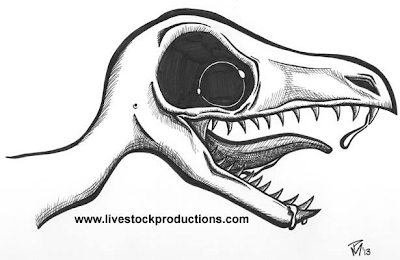
Small toothy cartoon dino with ferocious or mischievous look.


Tell us some more about panel creation.  Describe your typical drawing session and environment.

My drawing session varies, honestly. Usually, it's a back-and-forth session of making a few marks here and there in between social networking and internet browsing all while playing tons of music. Eventually, I can get myself into a sort of zone where I am just drawing and everything else around me fades away which is when I really lose track of time. So my environment is my desk. I don't travel with my drawings too much. I like my flat surface with my computer and all my dinosaur figurines around me.

I like that you have the figurines around you. Are they like totems?

I would say the Stegosaurus is my totem animal.

What kinds of drawing tools do you like to use the most; what are the most important items on your creativity bench?

My tools of the trade are a non-photo blue pencil, Bristol smooth paper and an assortment of Micron pens. Of course, I use my computer a bit, but that is primarily for arranging panels, adding text and cleaning dust and debris from the drawings.

My most important items? I would say that my figurines are right up there, but I love to get into a zone with just the right music. Besides that, I need to be ready to "play" because I believe the energy I am feeling is transposed to the paper.

I try not to "work out my frustrations" too much when I'm drawing. When I'm inking it's OK because at that point I have the majority of the drawing planned.

Could you share a few of your top creative-process music selections?

Music... well, I listen to a lot of film scores, modern day classical, as I think of it. But I also try to keep things upbeat as well. Lots of Oingo Boingo, Punch Brothers, Nickel Creek, Rockapella and of course Weird Al.

So from the past into the future, what else would you like us to know about your upcoming comic “Not Quite Extinct"?

I did want to mention that "NQE" has been resurrected a few times. In high school I planned on making it into a comic strip, however, it never made it past conceptual designs. In 2004 I pitched it as a TV show and it didn't fit the goals of the networks. At that point I attempted the graphic novel and became frustrated with it after 13 pages.

Yes graphic novels go long.

Well it wasn't that. It just wasn't gelling. So this is a big project for me because it is this life-long unfinished saga. It has followed me for years.

Sleeping Stegosaurus Illustration for Not Quite Extinct by Phil Machi


Do you have any regrets in your creative life? 

My only regret is that I haven't created MORE! I have so many other projects in my head and unfortunately I am a slow and meticulous artist. So whenever I complete a book, it is special for me because I just proved to myself that I could focus my mind on a single task and see it through to completion.

Have you learned something of value from missteps that you think emerging artists can benefit knowing about?

Missteps... well, for a while I was having a real difficult time prioritizing my life. My art would take a back seat to video games or TV. This is no longer a problem. While I am a little sad I don't do those things as much, what keeps me going is the result. I can watch TV for hours and have nothing to show for it, which frustrates me.

Would you say it is important to highlight the achievements to keep future goals in focus?

With a project this big, it's all about the little victories! It is so easy to get overwhelmed by a massive goal but the trick is to just break it down and make each individual section into a goal. Celebrating those little achievements can help you feel that you're moving forward. Personally, I'm not good about highlighting my achievements for very long. It really is sad to me because no sooner have I celebrated then I am off to the next thing! I like keeping busy but it is sort of like never being satisfied. But yeah, creation for me has always been its own reward. I don't get as much of a high off of compliments because at some point I had the realization that they're all just opinions and if *I* wasn't happy then nothing would sway me from that.

Well it is not a bad thing to be self-motivated towards being happy with your work.

True, but there is part of me that wants to celebrate a bit more. I just know that I have a little fear around getting an inflated ego. I've been reassured from close friends this will never happen but I always keep myself in check. Ultimately, I try to bring a smile to my own face with my creations.  I make it a point to be true to myself and in the end I know I am putting work out there that I can believe in. The icing on the cake is when you meet someone else who believes in it too.

How do you promote your art locally?

Locally is limited to word of mouth when I meet people and find an appropriate time to bring it up; but also in conventions. Conventions are a great way for people to discover new art and I love being in that scene.

Where can readers see more of your work?

NQE has its own page here: facebook.com/NotQuiteExtinct
Phil Machi (philmachi) on Twitter  twitter.com/philmachi


Steve Morris is from a small farm town in Southern Iowa.  He has always had a passion to draw and has been doing so since the age of about 8-years-old. Over the decades, his passion for drawing and art in general has grown and expanded to the point where he is always trying new mediums and surfaces.  Morris draws, paints and even etches to create interesting original pieces. He likes to work with an assortment of different kinds of ink pens and will use color pencils blended in among the ink in some pieces. Many different types of mediums and surfaces are utilized in his artworks. Most notable is his unique style which so many people inquire about and comment on how unusual it is.  As there is not an exact proper name, Morris says that he has always referred to it as a diversionary style
"It is a style, I've been told since I've been drawing, that is original and not often seen."  

New Castle © Stephen Morris


When did you start to think of yourself as an artist?

I have been drawing for the better part of 50 years and although I have been told for many years that I am an artist, I have also been accused of being entirely too humble and my own worst critic. So, for the majority of my creative years I never thought of myself as an artist until probably around 5 years ago when people started accepting and letting me know the appreciation they had for my diversionary, no-boundaries style and crediting it as a true art style.  To be honest, I am still somewhat learning to accept the title artist!

What makes ink your preferred medium?

Ink has become my preferred medium, in part because even as a child I was always drawing something on anything I could, so I always had a pen in my pocket. Since that is what I always have at my ready, I have learned to work the different inks and master using them in so many different ways, from blending bold lines to the finest details and shadowing.


Tell me about other mediums you most enjoy creating with:

I don't always use just inks; some of my pieces include inks, colored pencils spray paint even some acrylic paints that I blend all together in different layers with different brushes and manners. I like to experiment using different mediums together that as a rule they say can't or shouldn't be used together. I also do a lot work on glass. I etch the same finely-detailed kind of pictures and pieces I do on paper on to glass bottles, flat glass, mirrors and even old vinyl record albums with a Dremel and wide assortment of different bits. I often after etching a picture will go back and blend light shades of color into it with various types of mediums from inks to different kinds of paints. Creating etchings and art with a Dremel is something I started about 10 years ago, and I have been working at and experimenting with since.

Green Tree and Bridge © Stephen Morris
How do you define your style of diversionary art, and how does it stand apart from other established styles?

I would define my diversionary art style as art without boundaries. Art has always been said to be in the eye of the person admiring it, so my style is a style without boundaries - meaning the person who is admiring or just even looking at it, is allowed to and can see what they want to see, and not necessarily the same thing that someone else sees. They are free to make of it what they want unlike some of the other established styles where, say, a tree is a tree to everyone who looks at it. The story I intend for my art to tell is whatever story the person looking into reads. My art means a lot to me, it represents my feelings, thoughts and places in my life, both physically, mentally and emotionally. I guess that would lead into the answer to the next question,

What inspires you to create art?

It has been over a year since our first interview, when Tanya Davis was first expanding her creative work from sculpting and painting figurines to applying the same skills onto vinyl platforms. After all this time and
Penguin Engineer steampunk drawing penguin wrench watercolor pencil
Penguin Engineer by Tanya Davis


checking in regularly, there has truly been no pause in her actively making new art. In this interview I will attempt to bring our readers up to speed with her latest artistic endeavors.

How far has your experiment with vinyl platforms taken you?

It is still going and I am still trying different platforms. Most recently, I am tackling going larger. Outside of the initial MunnyWorld brand, my most successful work done on blank vinyls has been the Google Android mascot and Zukie bases. My most recent droid is a Penguin Engineer based on an illustration I created by the same name.
Penguin Engineer Droid Tanya Davis android figurine
Penguin Engineer Droid by Tanya Davis


Illustration, that is something new.  How did you get into that type of art?

It was more about me practicing drawing and also giving my hands a break from sculpting. Aside from chiefly commission figurine work, illustrative drawing and painting is my main art form right now.

Since the beginning of 2014 which one of your illustrations is your personal favorite? 

My Penguin Engineer because it is the first original character I created that has a completely developed background. It was done free-hand from start to finish on the illustration board without any transferring. It was also the first one I did with the Derwent watercolor pencils. This illustration is currently available in limited edition signed watercolor prints done by local printer Mindzai Creative. Right now (mid-June 2014) there are 18 left. I have them on hand when I publicly show my work or you may obtain this print here.


Choosing the right art teacher is one of the most important decisions an artist makes whether just starting out or trying to build upon their current knowledge. Although the responsibility to learn falls on the shoulders of the student, the true accountability of the student's success is dependent upon the art teacher's instruction. The student of a poorly suited instructor will often assume fault with themselves, thinking that they do not possess enough natural artistic talent.
Simplon Pass: The Lesson  By: John Singer Sargent
Simplon Pass: The Lesson By: John Singer Sargent


Beyond the scope of students being "herded" into classes which adhere to a quantity over quality kind of learning environment, there are the teachers that leave the students to figure it all out for themselves.  An example would be a teacher who asks students to draw random things, and then critiques once or twice yet not really giving any advice. Drawing and painting classes like this are taught entirely with the irresponsible method of "if it feels good go with it."  Unfortunately not everyone can "feel" their way into learning how to capture light, drawing proportionally, the use of color theory, etc.  Sadly it is an overly common scenario where a teacher employs a passive form of teaching which leaves the students frustrated and grasping in the dark. 

With literally thousands of art instruction classes available, how should you choose an art instructor that will teach properly? In regards to choosing an art teacher here are a few pointers on what to look for. I hope this will help guide you in your search for a good art instructor.
Man Painting the Letter A  By: Pop Ink - CSA Images
Man Painting the Letter A 


1. How do you feel about the teachers work?

It's important to like or at least respect what your teacher does. No matter how objective they are, the teacher will only be able to teach you what he or she knows - which will be reflected in the artwork they produce. On the other hand, do not let this be your only basis of judgement of the prospective instructor. Teaching is not the same as creating and some teachers make great art but are sadly lacking as instructors. Some teachers are burnt out and lack the degree of intention necessary to help students through the rough spots. More than the knowledge and talent to merit teaching art, it is more important that they make it a top priority that you learn from their class.

2. Does the syllabus begin with the fundamentals?

A gradual approach is basic to teaching. You start with the most basic fundamentals and continue along the learning path. Too many times a teacher makes the assumption that a student already possesses complete knowledge of the fundamentals, or worse, the instructor is not familiar with them enough or patient enough to teach them.  Sometimes this is just a matter of the teacher having been involved in arts for such a long period of time that the use of the arts fundamentals is automatic, in this case they tend to no longer be aware of them. This type of scenario is a terrible failure on the teacher's behalf - but it does happen.

3. Are you actually improving?

If you are enrolled then you should look at the results you have thus far.  Your teacher should definitely be guiding you on proper technique, teaching you about theory and giving you a solid foundation. Are you learning how to draw when you are in class or are you just drawing? If your work is getting better that is a pretty good indicator that you have found the right instructor.

4. Are you being treated as an individual?

We all have different strengths and weaknesses. The good art instructor will realize this and treat each art student as an individual. A poor teacher treats everyone exactly the same or has a few favorite students. If this is occurring, find a new art instructor.

5. Is the class overcrowded?

Typically you do not want to be in a class with more than ten students to one instructor. Since everyone is different in regards to ability and art awareness there has to be a way for you as a student to receive one-on-one instruction with the instructor. Being in an overcrowded art class run by a mediocre teacher is enough to curb the enthusiasm of any eager art student. Simply demonstrating the basics of drawing and painting as a one-size-fits all approach without interactive discussion obstructs from learning. When this happens, as it tends to do in overly large groups, it promotes a sense that drawing and painting is just too difficult to learn.

6. Are you training with people you like?

It helps to learn in an environment with people who encourage and support one another, admire each other’s efforts, and are genuinely pleased to see other's progress. It is very beneficial to have classmates with whom you can also discuss art with. Companionship within the arts spurs growth in the artist.

7. Are you being made to compete against others?

Some teachers feel that competition is needed among students is necessary to inspire them, and it is not so. Perhaps this scenario is more interesting for the teacher but it does nothing for students in the arts. You should only be competing against your own limitations.  Arts are not clear-cut enough to allow objective judgement in comparisons of execution in expression in this manner.  This is why, for instance, a physical art such as large scale sculpture is not a sport, it is an art.

8. Is the learning environment one in which you feel safe and comfortable?

You must feel safe and secure in your classroom.This is especially true when learning an art form where the stakes are so high and the intimidation factor can be so great. If you feel intimidated in any way when you go to class, it's probably the teachers fault, even if it stems from other students. A competent art instructor is in control of the students and is responsible for how they interact in the classroom. Some instructors intimidate students with an overbearing manner.This often happens when the teacher sets themselves up as a major authority on the subject of art or an unattainable example of artistic talent.

9. Is the criticism in class not helpful?

An overly critical teacher can make you give up. No, this is not just the way art teachers teach, although there are those that almost exclusively use critique as their method. Do not underestimate the significance of a good critique. However, there are great artists that cannot communicate well enough to give constructive criticism. Instead of continually pointing out what is wrong with what you are doing, a good teacher should also give you tasks which will guide you on how to improveIf your instructor just walks around and then gives input, the input should be informative and helpful. Ask yourself if you feel better since you started the class - better about your ability as an artist and your confidence in achieving your goals. If not, change teachers.

10. Are you getting individual help?

Maybe there is a concept or technique you don't quite comprehend or just can't put into application. Does the teacher take the time to help you? Are they also patient with handling your question or problem? Can the instructor get to the root of what you are having a problem with and help you figure it out? If not you are wasting time and money.


A good art teacher should cover fundamental skills one-by-one, ensuring mastery by the students before going to the next, to improve their pupils' skills. If this is not happening something is wrong with the instruction. A good instructor must have the ability to break down required skills into steps simple enough for you to learn successfully. If you aren't improving and enjoying your learning experience in the arts, your instructor is failing on one or more of these points.


The Supreme Art of the Teacher
The Supreme Art of the Teacher 

Review these ten tips to pinpoint exactly what the problem is. If you find that you cannot fix it by speaking with your instructor, you should move on to a new teacher. Art can seem very difficult to a beginner. You may think you cannot do it or feel you do not have enough talent, but a good instructor knows that you can and will show you how. It is one thing to know how to do something, in this case art vs teaching. Being able to teach effectively, is an art in its own right. Not all artists are teachers, just like not all teachers are artists.

What do you feel makes a good art teacher?  What positive experience have you had? Have you had a teacher that failed you? How did you respond?  Please share your experiences and observations by commenting below. Also let me know if there are any important points I missed, thanks.


Key reference source: Larry Gluck, artist and educator 
© Rebecca H Knight, images are © their respective owners. All rights reserved.

Brian Kielt is a Visual Artist living and working in Northern Ireland with painting, drawing and photography. His practice in Figurative, Neo-Expressive art revolves around personal experiences, mythology and a sense of mortality/fragility. Brian creates artworks in oil, charcoal, pencil, pastels, photography and mixed media.


Painting, mortality, brian kielt
Fractum,  2013  © Brian Kielt 
Tell me how you began creating in your current medium:

I first used Oil when creating a painting in school at 14. Since being used to only acrylics or watercolours, there was definitely a learning curve. It began as mud and then slowly the realisation came that cleaning and preparation was half the battle with Oils. I first experimented mixing Oils with other medium when I was halfway through my Fine and Applied Arts course in Belfast in 2007. I haven't looked back but I'm still constantly pushing the materials and developing my practice with them.


How long have you considered yourself an artist?

3 years. During university I always felt I was in a bubble and so the 'art student' tag fitted me perfectly. Once I left university I was forced to stand on my own two feet, find a studio, sustain my practice and apply for competitions; which is when I felt that my professional Artist career began.


Painting, mortality, brian kielt
Exspecto,  2013  © Brian Kielt 

What things inspire you to create art?

People mostly. We are fascinating. The figure is usual extremely prevalent in my work. Memory and experience go hand in hand in my opinion and so they jump in from time to time, especially when an experience triggers a said memory or vice versa.

What are you trying to convey through your art, and what does it mean to you?

The fragility between life and death. Mortality interests me a lot because I lost quite a few close friends and family members over a short period of time and it was a dark point in my life. This time still haunts and inspires me at the same time. I try to figure out why it scares and excites.


Painting, mortality, brian kielt
Beth,  2013  © Brian Kielt 

Tell me about influences, if any:

Francis Bacon is a massive influence on my work. He blew open what it was like to explore the human condition through the medium of paint. Gerhard Richter, Hughie O' Donoghue, Paul Nash and Edvard Munch also spring to mind immediately. There are so many influences beyond painting as well.

Photography can trigger an idea for a painting or a large-scale drawing quicker than a painting by someone else because you can immediately see what you would do in your own style, your stamp; rather than deciphering someone else's paint/handwriting and then building it up again.


Local artists are a huge inspiration to me. Eoin McGinn, David Lee Badger, Louise Younger, Craig Donald and Gemma O'Hare came through the same university system with me so I have had the privilege of seeing their work from day one; watching it develop and grow. We all feed of each other's creativity so the idea of a bubble in university has lingered on in some regards!


Painting, mortality, brian kielt
Opacare,  2013  © Brian Kielt 

Tell me about your creative process, from the beginning of a work to its completion:

It usually begins with a found image or maybe a quick 5 minute sketch of someone/something. I either blow the sketch up on a projector or develop it from hand onto the painting surface (varies from canvas to board). Then layering of charcoal drawing, washes of turpentine and oil paint repeats itself until either it is finished or I can go no further that sitting because I will destroy the work if I try to fix it. If I cannot finish it in one sitting, I let it stay on my wall for a week and begin another. If inspiration still hasn't come after a week I hide the painting for a month and then take it out to view it with fresh eyes. The layering process either begins again or I wipe the image clean and start another.

What exposure have you had?

I won a competition for the Stendhal Arts Festival in 2011 for a portrait of a fellow Artist. I have since had several exhibitions in Belfast: Culture Night Belfast 2011 & 2012, Ulster Bank Arts Festival and Opening Exhibition at the Muse Gallery in December 2012 to name a few. I had a review about my work recently in an online magazine which was great!

What is the most annoying remark made to you about your art?

There have been a few but the one that sticks out the most was "So, when are you going to get a real job?" It took a while to laugh my way past that one.

Do you have any regrets in your life as an artist?

I don't really believe in regrets but perhaps being more disciplined than I can be at times.


Painting, figurative, brian kielt
Silvis,  2013  © Brian Kielt 

What plans do you have for the future of your art?

I'm in the middle of organising my first solo exhibition for the end of this year; there is Culture Night 2013 in September in Belfast where I and fellow Artists are planning something a little different to the usual proposals. Generally I hope to gain more exposure for my work which will enable me to continue my practice and develop as an Artist.

Do you have any advice for emerging artists?

No one ever knows it all. We are all constantly learning so the one thing I would encourage for anyone starting off is to keep an open mind in all areas of your work and to create something first instead of questioning it. If you ask why before it's even made, then there is no point in making it in the first place.

I try to sketch for at least an hour each day. This loosens your brain up and a little mark here or there can lead to something else.

How do you promote your art both on and off the internet?

I'm one of the founding members of the LOFT collective, a group of emerging visual Artists based in Belfast's city centre. Together we enhance our individual practices - ranging from painting, sculpture, photography, web design and many more - as well as collaborate on group projects and exhibitions. Twitter for LOFT collective is @LoftBelfast

I have open studio days where the public can come up to view my work and see my process. On the internet I use my blog, Facebook and Twitter primarily although I'm also on LinkedIn.

Have you sold any of your art, if so how?

I have sold several pieces, mainly through the group exhibitions I have been involved in.


Painting, figurative, brian kielt
Solatium,  2012  © Brian Kielt
How should people find you online...

I have my portfolio, blog, C.V. and more on my Artist Website and can be reached or followed on Facebook and Twitter: @BKieltArtist. There is also a link for the LOFT collective.


all images ©Brian Kielt 
Illustration art of blue peacock by Morgan Allain
Louisiana native Morgan Allain, a.k.a. The Inkling Girl, is a self-proclaimed "nerd" and she reflects this in the geeky nature of her art. I had the opportunity of discovering her art at the 2013 Wizard World Comicon here in Austin. There were so many cool artists in the Artists' Alley at Comicon and Morgan's booth was an instant favorite. From the first look through her artist portfolio I could appreciate her unique artistic style. It is with this creative flair that she re-creates images from television and movies. She also makes wonderful original depictions of animals. Her preferred mediums are watercolor, ink and colored pencil. It's a family affair, being that her husband Danny is an artist as well and sometimes they get to work together. 

Where did your artistic journey begin?

Drawing is something I have enjoyed for as long as I can remember. My grade school teachers would comment on that, in fact. I started becoming really interested in it around 14 and just kept at it. Took lessons here and there, but I was really just self-taught until college.

I attended McNeese State University and I have a B.A. in Art; my concentration was printmaking. Mostly relief printing; linocuts were my favorite. Never took painting of any kind in college. Printmaking was too expensive for a recently graduated newlywed working at Starbucks. I bought a watercolor set after I graduated, just to tinker with.
Morgan Allain original art cat skull illustration with rainbow colors streaking downwards

How would you describe your style?

Ooh. I don’t even know if I have a style! I guess maybe it’s sort of pop art inspired. I feel like my style is always evolving and changing. I really enjoy finding people that appreciate art that showcases stuff I've loved since childhood. Artists who have influenced me are Audrey Kawasaki, Glenn Arthur, Olga Noes and Tony DiTerlizzi.

What things inspire you to create art?  

I find inspiration in many many things: Books, Movies, television, animals and other artists. I've been a huge fan of Buffy the Vampire Slayer since my teens, so I have a whole series of portraits of the characters. I love the movie Labyrinth and have created many pieces from it. I love painting birds! I don’t think I’ll ever tire of painting birds.

At what point did you begin to consider yourself an artist?

Gosh, even now I don’t always consider myself an artist. Most days I’m just me: a total geek, a wife and mom… just a girl who loves to create. I think the day I start putting “artist” in front of all my other roles is the day I need to chill.

What is your favorite project created in your current medium? 
Morgan Allain Buffy the Vampire Slayer Fan Art Portrait

Usually whatever the last thing I drew/painted is my favorite. I’m most fond of my peacock, “Blue Wild” and “Skull Candy Kitty” at the moment.

Would you like to share a little about collaborating with your husband on artwork?

Danny and I collaborate once in a while. We both always have some projects or commissions going on, so we can’t combine forces often. The last collaborative piece we did was called “Cherry Bomb.” Danny did the initial drawing, which I then transferred to watercolor paper and painted. We were both really pleased with the final piece; it was so much fun to see our distinct styles mesh that way.

Fun fact: when Danny and I were being interviewed by the priest that performed our wedding, he (the priest) asked each of us what we loved most about one another. I said something sweet about how Danny is so genuinely kind, blah blah blah. Danny said, and I quote, "she's good at drawing!" 

Yep. That's what he loves most about me. Haha!!

What is your creative process like from start to end?

It tends to change from project to project. Portraits always begin as sketches on scratch paper which I then transfer to watercolor paper with the help of a light box. I usually paint the background first, then start with the shadows on the face and slowly build up with many translucent layers. With the birds, I just wing it (ba-dum-tshh!). I grab a colored pencil and do a messy sketch on my watercolor paper and just go from there.  I rarely plan what I’m going to do, and I never know where it will end up. I just let it happen. I almost always listen to audiobooks while I work. Harry Potter, Chronicles of Narnia, Sabriel, Sarah Dessen books… I’m such a nerd!

What exposure have you had?
Morgan Allain Illustration from Narnia Chronicles

Ha! Um. I've only been in a few shows. I’m terrible at proactively promoting myself! 

Do you have any regrets in your life as an artist?

I wish I had made more time for it before my daughter was born. I really slacked off from college graduation until she was born. I still painted, but not nearly as much as I do now. I worked a lot and used that as an excuse. Since then I’ve realized that was a pathetic excuse, I can nurse an infant while painting!

What plans do you have for the future of your art?

My only plan is to continue creating, continue growing.

Do you have any advice for artists just starting out?

Draw as often as you can. Find other artists. Push yourself, branch out!

How do you promote your work both on and off the internet? 

On the internet I promote myself via social media: Facebook, Twitter, Instagram, DeviantArt. Off the internet, well… Unless I’m at a con or festival, I don’t really promote myself.
Illustration from Veronica Mars, Morgan Allain art


See more of Morgan's artwork at the following links:

All images © Morgan Allain, the inkling, inkling girlThe Inkling on Society6

Instagram: @the_inkling_girl


All images © Morgan Allain