Latest Posts

Showing posts with label essay. Show all posts
 By Michael A. Vidalis  
Shizuoka Press and Broadcasting Center  Kenzo Tange. Photograph by Jonathan Savoie
Shizuoka Press & Broadcasting Center by Kenzo Tange.
Photograph by Jonathan Savoie

Architecture as an art is required to be original, or at least it should strive to be. In the pragmatics of architectural practice though, one realizes that a host of conditions or determinants often interfere or intervene, so the resulting project is a far cry from it. Let alone that so called signature projects are equally unattainable for most designers.

It is rather uncontested, that a work of architecture in order to stand apart requires the simultaneous existence of two conditions: a gifted designer, as well as, a receptive or visionary client. It is very rare for excellence to be achieved otherwise. One of course can analyze this ad nauseam, thinking of all possible variations or sub conditions, but of no avail.

On occasion an architect has been successful in steering a client towards his philosophy, or convincing him of the merits of his ideas, but this is an entirely different subject, opening Pandora's Box. It is the debate having to do with the role of the architect, or his "obligation" to steer the uncultured masses... See Adolf Loos' "The Poor Little Man" and the notion of Gesamtkunstwerk. 

Interpersonal relationships are indeed rather complex. The architect-client relationship is deemed pivotal to the success of a project. Historically, patrons of the arts and architecture such as the Medici family in the Renaissance were instrumental in the creation of great works of art. To a lesser extent, men of great vision are still found today, providing the much needed impetus to grand or original works. 

It is often expressed by architects that a limited budget presents an impediment to creativity or their uninhibited artistic expression. To see how erroneous this view is, we need only bring to mind acknowledged architectural marvels that were accomplished with limited means, such as the little Schullin Jewelry store in Vienna, a project that was identified with the post-modern movement (Hans Hollein, architect, 1982). Or plenty of contemporary projects in the L.A. area, by architects employing humble materials in the elevations of the structure (For instance, see the Container House by Peter Demaria - 2006, the M House by Xten architects - 2004, or the Schmalix residence by Fung + Blatt architects - 2000). 

Schullin jewelery storeAnother objection raised has to do with the limited time allowed to design or construct the project. What about though fast-track design or fast-track construction? Lastly, an additional objection by architects has to do with the limitations presented by building codes. Again, being forced by limitations or constraints one has to reshape, reinterpret, reinvent or rethink the problem or its parameters at hand, thus presenting an opportunity for the new to surface. 

The list of architects that have achieved excellence in original artistic expression is long: Sant' Elia, Frank Lloyd Wright, Le Corbusier, Mies van der Rohe, Philip Johnson, Robert Venturi, Tadao Ando, Zaha Hadid, Saana... 

Analyzing the work of the above, or that of other architects - acknowledged leaders of a fresh approach in the 'arts' - pioneers in their own right (not only in the mind of critics but by general acclaim), we may try to analyze the underlying common factors, if any. How did these men develop, why did they stand out, and how did they contribute to a valid architectural discourse? How did they leave their indelible mark? How did the avant-garde come about? 

Some support that uniqueness is the reward, the eventual fruition of many years of plain hard work and insistence, questionable though as far as architecture is concerned, or for the arts as a whole as we shall later see (isn't the invalidity of this reasoning apparent when we attempt to justify the artistic success of many young or 'inexperienced' creators? As an example, one of the most monumental edifices ever built, La Grande Arche de la Defense (1982- 1989), in Paris, was the result of an international architectural competition with 400 entries from 40 countries. Winner, an unknown Danish architect, Otto von Spreckelsen, whose only experience was limited to designing his own home and two churches in his country! Or, the enigmatic house Venturi designed for his mother, Chestnut Hill, Pennsylvania (1962), his second built work). 

It is deemed necessary to refer to Professor Pavlos Mylonas. During his reception at the Academy of Athens and awarding of Membership, Mylonas said: "...in the most creative 20th Century, the Greek architectural family has treaded a path just parallel to the Modern Movement, as happens with most other not large [small] countries. Worth mentioning not because remarkable Greek designs have not entered the International Pantheon, but because - the subject tonight being Theory - since the days of the late Greek architectural aesthetician Panayotis Mihelis, basically no noteworthy Greek contribution has been made to contemporary international architectural thinking. And this, perhaps due to the fact that in our country the presuppositions were not in place timely, that could lead to the realization of an innovation ["modernism"]". (1.) 

The movement of fine press and book arts first began as a reaction against the industrialization of printing. Certain printers such as Horace Walpole and William Morris began to focus more on quality and matching of worthy texts with artistic expression as a way to enhance the experience of book readers. This is reflected significantly in the structure and design of such books with the goal to promote appreciation of fine press books and to encourage their production. This is pursued by increased interaction between book printers, designers in the book arts and the writers themselves.  In the Information Age we find ourselves in, it is not just mass production that is being taken on by fine press book makers – it is the actual physical nature of books itself!

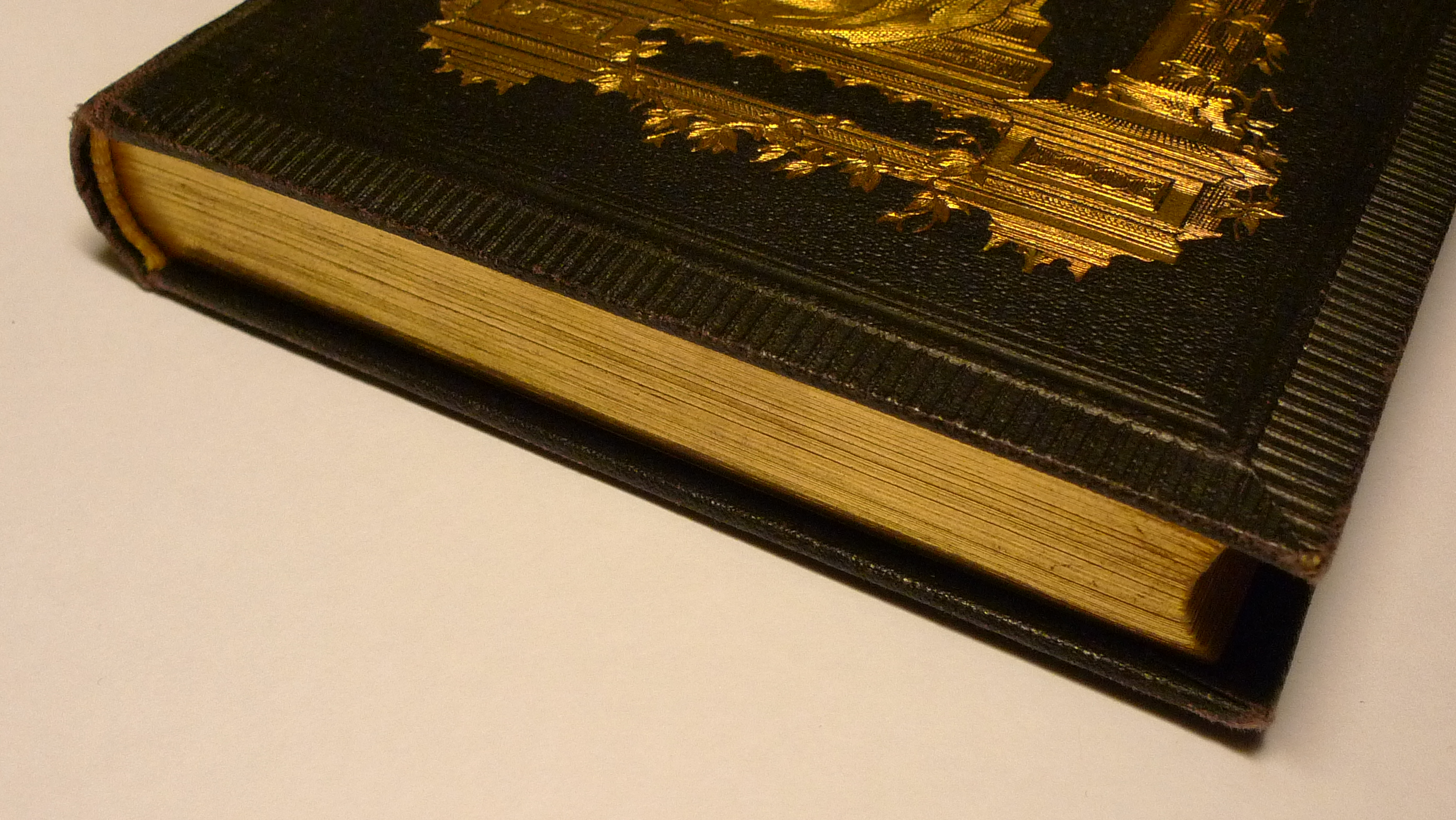
gilded book
As you see with this old book with elaborate gilding it is not a new concept.
image via  wikimedia

At this point, it should be taken into consideration just who is going to buy these more expensive fine press books?  The short answer is a simple supply-and-demand scenario.  First of all, accept that it is an economic fact that paper books are becoming less accessible for readers with limited budgets and/or space in their homes to keep them. This encourages book connoisseurs in such a state to more readily accept using e-readers and downloading digital books due to the lower prices available.  Even those with disposable income are still attracted to the bargains found in e-books and prize the practical ability to carry a virtual library around in the form of a compact electronic tablet.  As a natural result of the growing popularity and commonness of e-books, paper books are becoming increasingly rare. If a book is considered special as an object in itself, readers are persuaded of its higher value. Even now, paper books have become collectors’ items.  Some collect paper books based on their nostalgia-factor, others for the sensory experience that does not exist in digitized books. 

Slate Magazine’s Michael Agresta presents in his article What Will Become of the Paper Book? that as the role of books as “vessels for delivering text is lost to or taken over by digital, their other qualities will grow in importance.”  This idea supports that fine press books are significant now and will continue to be well into the future.  Fine press editions appeal to the nostalgic consumer of paper books and have a certain status symbol value separate from the mass-produced paper books.


decorated, partially leather-bound art press book
Dickens' Great Expectations in half leather binding.
image via  wikimedia

Even though new publications are now usually offered with a choice of hard-copy or electronic format, this does not herald the end of paper books. The fact that hard-copy is still offered affords hope that the homes of serious digital-age readers will continue to include paper books.  However, these home libraries will be curated in an increasingly judicious manner. So who will buy fine press books? - The people who buy them love books - as I do. They love handling them, are drawn to the illustrations, and admire quality of the typography and binding” says Colin Neville, handler and seller of fine press books online. Fine press books rival decorative art hung on walls with their characteristics of beauty, glamorous expense and intentional value. Bookstores are evolving an identity along the line of boutique shops or art galleries.  Even sellers of used paper books often have a section specific to antique or collectible books in their stores.  Fine press books have been around a long time and it can be expected that their tradition will grow and continue long after the memory of paper books as the norm is gone.  They will be both relic and modern luxury, which is the sense they garner in the millennial generation already.


Do you collect paper books?  Are there fine press books in your collection or have you considered adding them?  Please weigh in with comments about why you like them and how you feel about their significance in the past, present and future.  Share your ideas and let me know if there is something I have missed that should be discussed in the ongoing dialogue of the arts.

splashes of color marbled in paper such as that used in fine press books.
Marbled paper often used to decorate the cover interior on fine press books. 
image via  wikimedia


© Rebecca H Knight

Bookstores have been expanding the definition of what patrons expect - not only as a place to buy books. Other forms of media such as music, video, computer programs and even video and board games have been a fixture for a long while.  With the larger franchises you can get all this and more; would you like a box of chocolates, coffee, or tea with that book? The direction would appear to be towards anything that stimulates our minds.  A strong trend I have noticed in rare book boutiques and used book sellers is the combining works of writers with those of visual artists.  Come for the books, stay for the art OR come for the art, and stay for the books. Artists read and write books after all, whether of the coffee table variety or instructional. As such, you may buy a book about art and/or get something to decorate your home.  Sometimes the booksellers hold events more akin to those of an art gallery, complete with opening parties for exhibitions. Is the book + art connection a branching out for the enterprise, or is it perhaps an adaption to stay relevant, or even just to capture a certain niche? 


jim houser, bookshop, art
Art display at bookshop

On one hand it is all art.  Literary art is an art form so the book itself is a work of art.  Even though many book shops are just wall-to-wall books and an art gallery is usually just the opposite but with visual art pieces instead of books, there are certainly instances of overlapping.  In fact, art galleries also will be seen to include a corner devoted to books.  Authors team up with illustrators and find themselves together at book-signing events; also art and literature are naturally very closely interwoven in the creation of graphic novels.


farewell, books, austin, bookstore, art
Farewell Books, first day.


A prime example of the art displayed in bookstores phenomena, Farewell Books is a progressive bookshop and art gallery that specializes in new and used hard to find books and magazines.  Farewell Books sets out to provide space for contemporary culture and community. In addition to release parties and poetry or prose readings as one would expect at bookstores, the owners host art openings, performances of theater and film, workshops, and so forth.

Another way in which book stores and visual art have come to intersect is in taking old books that are victim to time and are disintegrating and crafting them into artworks.  “Altered books” is a term for art made from disused old books incorporating elements of origami or sculpting in the process. You may find workshops that encourage book art or altered books held at used bookstores or libraries. This art reclaims outdated books in poor condition and turns them into unique even beautiful creations.  One that I know of in my community shared their reason for promoting altered book art: “The goal of Recycled Reads is to extend the life and maximize the use of books and media and by including crafting and up-cycling we can help meet the City of Austin's Zero Landfill goals. ”  So in this manner, a process of creating art and sourcing media to do so in the form of worn out books is good for raising awareness for the environment.  If you think about it, papier-mâché brought old newspaper media into the hands of artists in a similar fashion.


Altered book art, Lauren Moss, Black White and Red All Over
Black White and Read All Over  © Lauren Moss

Books and art media in their physical forms are being rapidly transformed into digital versions in our technologically advanced age. Digitized media are admittedly easier to store, replace and preserve, however, the characteristic of tactility still draws us to want to hold and have a more personal experience with books and art. A book shop is primarily a place for books, so it would be safe to assume that first time visitors expect only books - yet they find themselves intersecting with the art displayed along with the literature.  It is an innovative way to combine two cultures into one to enhance the experience for people browsing book stores to learn new stuff, find a non-specific gift or maybe just there to pass time.

Please feel welcome to comment with your experiences and opinions, or tell me about another place you know of that has a similar setup.  Share what you know as a patron or a shop owner. I am curious and want to learn more. This is so many things I love rolled into one - art, books, business and innovative commerce.  


© Rebecca H Knight, all images and media used are © their respective owners. All rights reserved.

Ship figureheads have been around since people first set out to sea. Skilled maritime wood carvers create figureheads to appease a blend of superstition and self-promotion. Often in the form of elaborate wood carvings, they were meant to embody powerful spiritual forces to protect the ship. Also they symbolically show how sailors believed that a ship was not just a thing but an actual living being. This thought also ties in with the idea that in order to find its own way the ship needed to have eyes. These are incredible works of art which are often less considered in this modern age; however there were artists working alongside ship-builders over a long stretch of history - and still are to a limited degree.  No ship went to sea without its eyes.


figurehead, woman
Figurehead of the Falls Of Clyde - the only surviving fully-rigged, four-masted sailing ship left in the world - built 1878, Port Glasgow, Scotland. This ship was originally a full-rigged ship designed for global trade, later re-rigged as a Bark. This tall ship permanently moored in Honolulu Harbor at the Hawaii Maritime Center.


You may tend to think of figureheads as a prelude to hood ornaments - which are also being seen less frequently these days.  The figurehead on a ship at first was not just mere adornment, they were meant to represent matters important to seafarers.  In Ancient Egypt, for instance, figureheads were perceived to offer protection and vision, in the form of holy bird figures mounted on the prows. Roman ships often made show of their elite fighting capabilities by having a carving of a centurion in place. Phoenicians used the heads of horses as an embodiment of swiftness and Greek ships had boar heads to represent ferocity to frighten possible attackers.

Northern Europeans often decorated their long ships with a serpent figurehead. Some ships also had dragons, dolphins, or bulls. These were meant to fend off enemy ships along with their enemy's guardian spirits. Alternately ornate as opposed to fearsome, the swan became very popular in the 13th century; it was thought to imbue the ships with grace and mobility.  The figurehead carvers created for the seafarer a symbol of good luck carved and painted to represent a guard against being lost or otherwise compromised at sea.
Kalamar Nycel bow figurehead
The bow of the Kalmar Nyckel, a replica built in 1997 of the 1625 ship that carried the Swedish settlers that established New Sweden in 1628, now the modern city of Wilmington, Delaware, USA

Originally mounted on or carved directly onto the stern of the ship, figureheads were changed to the bowsprit following the forecastles taking their place above and protruding out from the ships' stern for a brief period in the middle ages. 17th century warships often had more elaborate designs to denote the relative importance of the ships, sometimes depicting a scene not just a roaring lion for example. In the late 18th century carvings came to represent the name of the ship which proved practical in the manner that many sailors could not read. Feminine forms usually bare-breasted rose in popularity due to sailor superstition that a naked woman would calm a storm at sea.


The industrial changes from sail to steam and from wood to iron in ship technology brought on the gradual decline of the use of figureheads. In the twentieth century ships began to have medallions or shields with figures as side-supports. The loss of the bowsprit, which was just above the usual placement site of a figurehead, is cited as a leading cause for the disappearing figureheads.


Mariners Museum Eagle
Eagle figurehead from the USS Lancaster, circa 1880 John Haley Bellamy, carver

In looking over figurehead carvings on ships from ancient times to today, we see much has changed. Some smaller modern ships and yachts will have figureheads according to the desire of the builder or owners. These tend to serve as decorative flourish that conveys a sense of prosperity and pride. Depending on who you ask, the use of a figurehead may just as well hearken back to demonstrating the spirit of the ship and serve to bolster the identity of the ship and its crew.


BelvaLockwoodShipFigurehead
Ship figurehead of Belva Lockwood


The figureheads of ships of bygone days are now shown as wood art sculptures on display in nautical museums such as the exhibit of the East India Hall in the Peabody/Essex Museum in Salem, Massachusetts, USA.  One could argue that in this way, past all the other meaning and purpose intended for figureheads, that they even serve as lasting symbols of ships similar to the purpose of graveyard statuary. 

The art form is not entirely lost and has its own particular facets of construction and problems unique to carvings in wood of this size - imagine working with a 14 ft., 3-ton block of wood to be carved in a way that will display properly at a 45 degree angle!  Maritime wood carvers today find themselves commissioned to make figureheads for replica ships and often apply their skills into making smaller versions of figureheads, even desk-top sized ones. Coat of Arms and even totem-poles are other types of wood carvings created with their specialized talents, and they often are called upon for restoration work.  


figurehead carver
Jack Whitehead - one of the
 great maritime carvers of the 20th century.
"Of all the objects made by man, the ship almost achieves a life of its own. When considering a figurehead, therefore, it is important to remember the ship that bore her. The ships have gone, but these wooden angels remain to tell their tales to those who care to listen." - Martin Jeffery, Ship Carver 


images used are public domain or © their respective owners. 
If you are a creative type, you may at times find everyday concerns can put you into a predicament:
You want to do your art in order to relax - yet you need to detach from your worries and just be in the moment in order to allow the creative energy to flow. 
How can you tune your brain to a state of tranquility and vivid imagination? Whether you seek outside-the-box brainstorming, access to your deepest intuitive thinking, or just a relaxing daydream-brain-vacation there are different ways to help achieve this by slowing the frequency of your brainwaves.


theta, theta wave, theta figure, theta art
Theta Waves, digital art © Eddie Arndt (with permission),
see more at his ASC Gallery 

We tend to spend most of our active waking hours in the high frequency beta state, in which our critical selective thought processes are enforced and determine that what we should pay attention to is what is responsible, logical, and realistic. Art, music, intuition, creativity and inspiration all fall outside the general focus of our minds when our beta brainwaves are dominant. Scientists have pinpointed that the theta state is dominant when our brains are on the verge of sleep. In a past article I wrote about creative writing and made note of the ability to tap into the dream or post-dream state as part of the natural process of pulling new ideas from the realm of imagination.


Concept of Electrical Activity in Neurons Electrical Impulses are Carried across the Synapse

Concept of Electrical Activity in Neurons Electrical Impulses 
are Carried across the Synapse by Carol & Mike Werner


Brain specialists find that theta waves activate memory, vivid imagery, new ideas and a deep lasting state of calm. Physically and emotionally we become soothed and allow creative thoughts into the forefront of our consciousness in this state. When finding a new idea, the "A-ha" moment, EEG monitors have detected a noticeable theta wave activity increase in study participants doing problem-solving exercises. For a common example, consider how when you are thinking really hard producing no solution but upon relaxing it just comes to you - this is an "A-ha" moment occurring with the slowing down of brainwave activity. Critical resistance in our normal state of consciousness gets in the way of being able to think about something new. The ability to think in a new way is the very essence of inspiration which all artists, writers, and musicians etc. strive for.

To learn about some methods you may try to induce theta state Click Here.